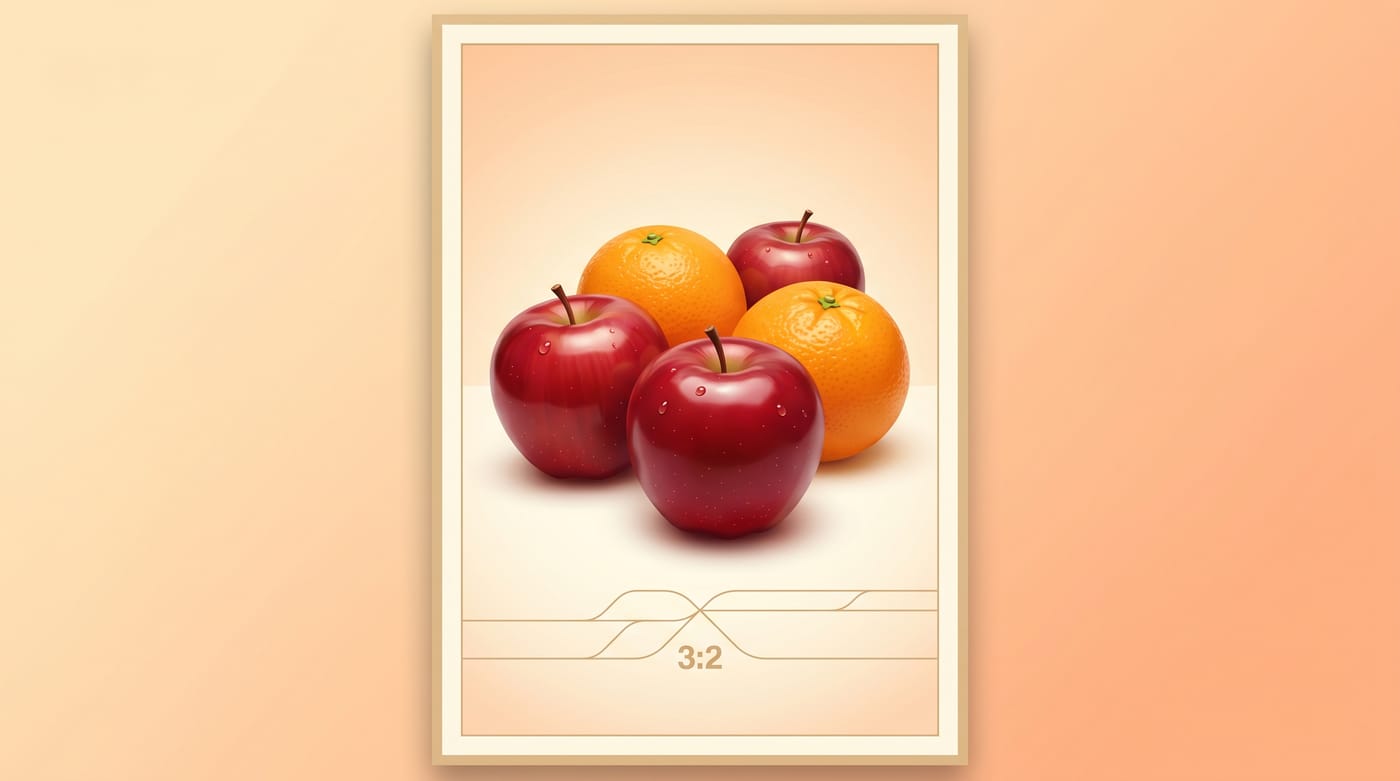
Lesson 1.1 — Understanding Ratios
A ratio compares two quantities — how much of one thing there is compared to another.
🎙️ Narration script
Hey there! Today we're going to talk about ratios. And here's the big idea: a ratio is just a way to compare two amounts. How much of one thing there is, next to how much of another.
Picture a fruit bowl. Inside, there are three apples and two oranges. The ratio of apples to oranges is three to two. We can write that as three to two, or with a little colon, three two. Same thing.
Now here's the part I really want you to remember. A ratio is about comparison and order. It is not about the total. And order matters! Three apples to two oranges is three to two. If you flip it around, two to three, that's a different statement. So always keep your numbers in the order you say them.
Let's try a recipe. Say you need two cups of flour for every one cup of sugar. That's a ratio of two to one. What if you want to make a bigger batch? You double it. Two becomes four, one becomes two. So now it's four to two. Those are called equivalent ratios. They look different, but they describe the same comparison, because you multiplied both numbers by the same amount.
One more quick idea. When a ratio compares different kinds of units, like miles and hours, we call it a rate. And a unit rate just means "per one." If three apples cost one dollar and fifty cents, then one apple costs fifty cents.
So, quick recap. A ratio compares two amounts. Order matters. Equivalent ratios scale both numbers by the same factor. And a rate compares different units, with a unit rate being the amount per one. Nice work!
1 Core idea
A ratio compares two quantities. If a fruit bowl has 3 apples and 2 oranges, the ratio of apples to oranges is 3 to 2. The key insight: a ratio is about comparison and order, not totals.
2 Key terms
- Ratio
- A comparison of two quantities (e.g. 3 to 2).
- Term
- One of the numbers in the ratio (in 3:2, the terms are 3 and 2).
- Equivalent ratios
- Different ratios showing the same comparison (3:2 = 6:4 = 9:6).
- Rate
- A ratio comparing different units (miles per hour, dollars per pound).
- Unit rate
- A rate with 1 as the second quantity ($0.50 per 1 apple).
3 Real-life examples
- Recipe: 2 cups flour for every 1 cup sugar → 2:1. Double it → 4:2 (equivalent).
- Marbles: 3 red and 2 blue → red to blue is 3:2.
- Speed (a rate): 60 miles in 2 hours → 30 miles per hour.
- Shopping (unit rate): 3 apples cost $1.50 → $0.50 per apple.
Reveal the thinking
4 Common doubts
Is a ratio the same as a fraction?
Not always. A ratio can be part-to-part (3 red : 2 blue) — not a fraction of the whole. A fraction is part-to-whole (3 of 5 = 3/5).
Does the order matter?
Yes. "3 apples to 2 oranges" is 3:2, not 2:3.
Is 6:4 the same as 3:2?
Yes — equivalent. Divide both terms of 6:4 by 2 → 3:2.
Ratio vs. rate?
A rate compares different units; a unit rate simplifies it to "per 1."
5 Step-by-step
- Identify the two quantities being compared.
- Write the ratio in order — three ways:
3:2,3 to 2, or3/2(thea/bform is just notation — it doesn't make the ratio a part-to-whole fraction). - Find equivalent ratios by multiplying or dividing both terms by the same number.
- Find the unit rate by dividing to get "per 1" ($1.50 ÷ 3 = $0.50 per apple).
- Use it to scale up or down (1 apple = $0.50 → 10 apples = $5.00).
📊 See it
Tape diagram — each box is one fruit; order matters.
| Apples | 1 | 2 | 3 | 10 |
|---|---|---|---|---|
| Cost | $0.50 | $1.00 | $1.50 | $5.00 |
Ratio table — scale the unit rate ($0.50/apple) up or down.
- A classroom keeps cats and dogs as pets in the ratio 4 cats : 3 dogs. If there are 12 cats, how many dogs?
answer
12 ÷ 4 = 3, so both terms scale ×3 → 3 × 3 = 9 dogs. - Are the ratios 6:9 and 2:3 equivalent?
answer
Yes. Divide both terms of 6:9 by 3 → 2:3, the same comparison.
Grounded in CA CCSS-M, Grade 6 · 6.RP.1 (Ratios & Proportional Relationships), California Department of Education. Hero image generated with Gemini Nano Banana Pro.