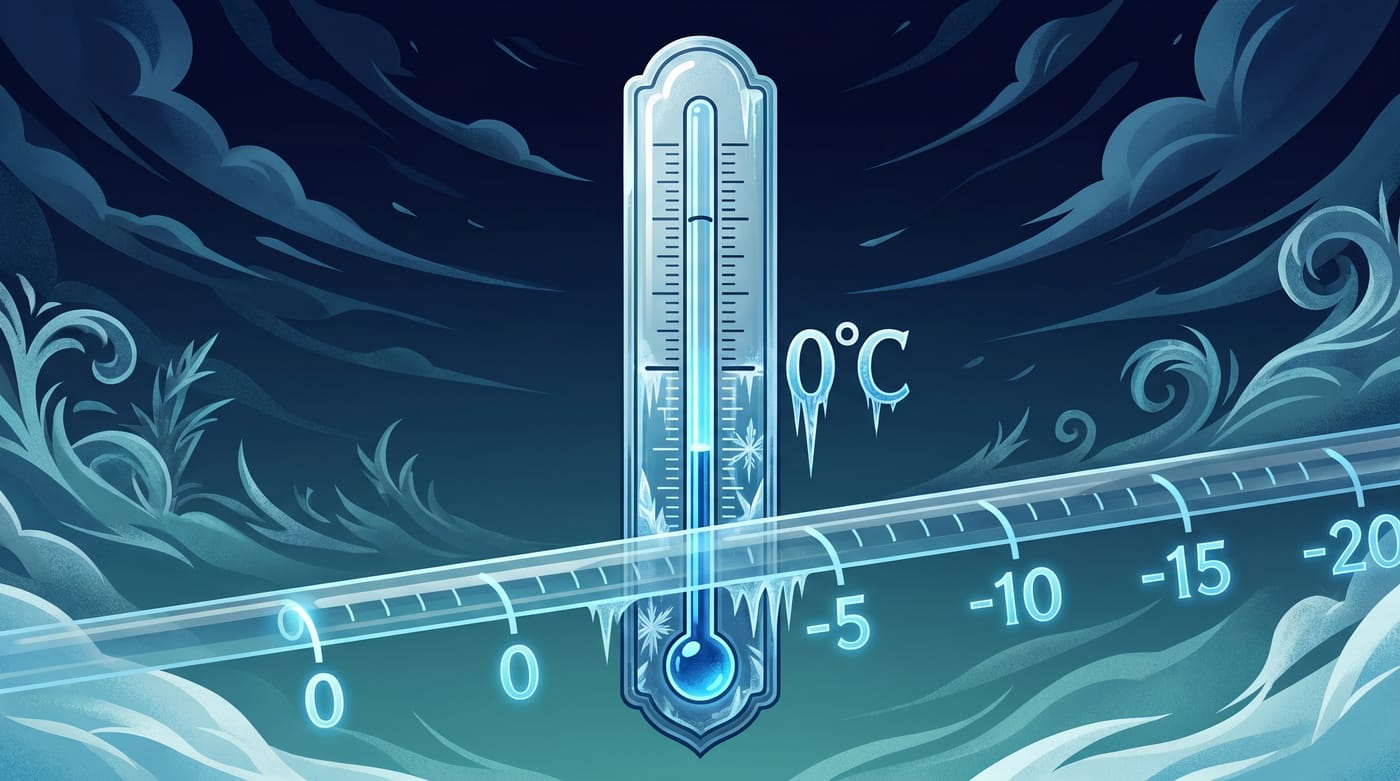
Lesson 3.1 — Integers & Negative Numbers
Numbers don't stop at zero — they keep going the other way.
🎙️ Narration script
Hey there! Let's talk about numbers that go below zero.
Up until now, you've worked with numbers like one, two, three, counting up and up. But numbers don't actually stop at zero. They keep right on going the other way. Those are called negative numbers, and a negative number is simply a number that's less than zero. We write it with a little minus sign in front, like negative five.
Here's a nice way to picture it. Imagine a number line. Zero sits right in the middle. The positive numbers march off to the right, and the negative numbers stretch off to the left. Put the negatives, zero, and the positives all together, and we call that whole family the integers. Integers are whole numbers and their negatives, so no fractions and no decimals.
You see these all the time in real life. When the thermometer reads negative five degrees, that's five degrees below freezing. If your bank balance is negative twenty dollars, it means you owe twenty dollars. Death Valley sits at about negative eighty-six meters, which is below sea level.
Now here's a fun idea: opposites. The opposite of a number is the same distance from zero, just on the other side. So the opposite of negative seven is positive seven. And the opposite of four is negative four.
One question trips lots of people up. Which is bigger, negative five or negative two? The answer is negative two, because it's farther to the right on the number line. Think about temperature: negative two degrees is warmer than negative five.
So, quick recap. Integers are whole numbers and their negatives. Zero is neither positive nor negative. Opposites are equal distances from zero. And remember, farther right means greater. Nice work!
1 Core idea
A negative number is less than zero — the opposite direction from the positives you already know. Zero sits in the middle, positives go right, negatives go left. We use them every day: temperatures below freezing, money owed, elevations below sea level. Together with zero and the positives, they make the integers.
2 Key terms
- Integer
- A whole number or its negative: …−2, −1, 0, 1, 2… (no fractions or decimals).
- Negative number
- A value less than zero, written with a minus sign (−5).
- Zero
- The boundary — neither positive nor negative.
- Opposite
- The same distance from 0 on the other side (the opposite of −7 is 7).
- Number line
- A line showing order: smaller to the left, larger to the right.
3 Real-life examples
- Temperature: −5°C means 5 degrees below freezing.
- Money: a balance of −$20 means you owe $20.
- Elevation: Death Valley is about −86 m (below sea level); a peak might be +2,000 m.
- Opposites: +3 and −3 are the same distance from 0, in opposite directions.
Reveal the thinking
4 Common doubts
What exactly is an integer?
Whole numbers and their negatives — no fractions or decimals. (−3 is an integer; −3.5 is not.)
Is zero positive or negative?
Neither. Zero is the dividing line between them.
What's an "opposite"?
Same distance from 0, other side. The opposite of −7 is 7; the opposite of 4 is −4.
Which is bigger, −5 or −2?
−2 — it's farther right on the number line. (Think temperature: −2° is warmer than −5°.)
5 Step-by-step (compare two integers)
- Draw a number line with 0 in the middle.
- Place positives to the right, negatives to the left.
- Compare: whichever is farther right is greater.
- Opposites are mirror images across 0 — same distance, opposite sign.
📊 See it · opposites on the number line
−3 and 3 are opposites — both 3 units from 0, on opposite sides.
- Put these in order from least to greatest: 4, −7, 0, −3.
answer
−7, −3, 0, 4 (farthest left first: −7 < −3 < 0 < 4). - What is the opposite of −9, and which of the two is greater?
answer
The opposite of −9 is 9. They sit the same distance (9 units) from 0, but 9 is greater because it's to the right of −9.
Grounded in CA CCSS-M, Grade 6 · 6.NS.5–6 (negative numbers, opposites, the number line), California Department of Education. Hero image generated with Gemini Nano Banana Pro.