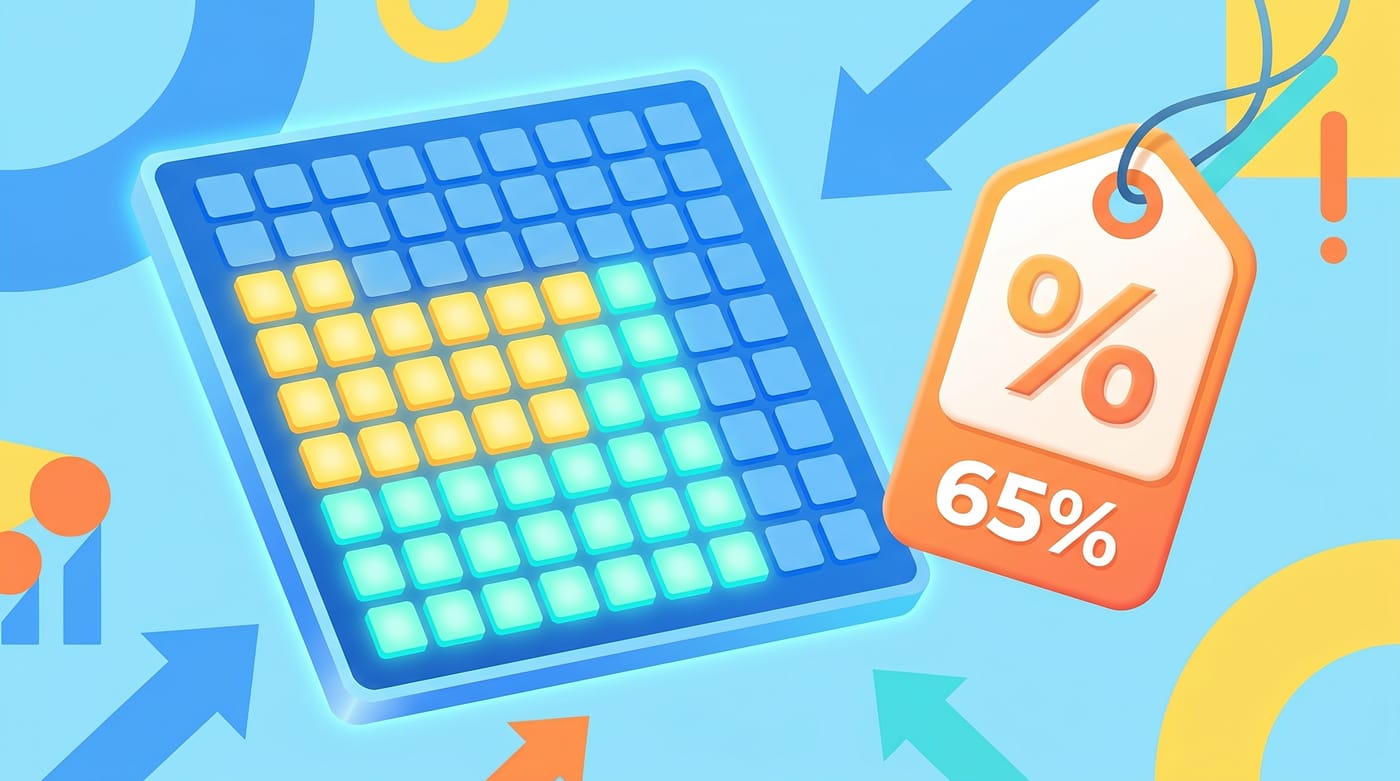
Lesson 1.3 — Percents
A percent is a ratio that compares a number to 100. "Percent" means "per hundred."
🎙️ Narration script
Hi again! Let's talk about percents. You see them everywhere, on sale signs, on test scores, on your phone battery. So let's really understand them.
Here's the secret: a percent is just a special ratio, out of one hundred. In fact, the word "percent" literally means "per hundred." So when you see twenty-five percent, that means twenty-five out of one hundred.
And here's the cool part. That same value can be written three ways. Twenty-five percent equals the fraction twenty-five over one hundred, which simplifies to one fourth, and it also equals the decimal zero point two five. Percent, fraction, decimal. Three outfits, same person.
Why are percents so handy? Because they put everything on one fair scale, out of one hundred. That makes different-sized things easy to compare.
Let's find a percent of a number. Say there's a forty dollar jacket, and it's twenty-five percent off. Step one, turn the percent into a decimal. Twenty-five percent becomes zero point two five. Step two, multiply by the whole. Zero point two five times forty is ten. So you save ten dollars, and you pay thirty.
What about going the other way? Suppose you got eighteen out of twenty questions right. Divide the part by the whole, eighteen over twenty, that's zero point nine, then multiply by one hundred. Ninety percent. Nice score!
And remember, one hundred percent means the whole thing. Fifty percent is half. You can even go over one hundred percent, which just means more than the whole.
Quick recap. A percent is out of one hundred. It equals a fraction over one hundred and a decimal. To find a percent of a number, turn it into a decimal and multiply. You've got this!
1 Core idea
A percent is just a special ratio out of 100. The word literally means "per hundred." So 25% means 25 out of 100 — which is the same as the fraction 25/100 and the decimal 0.25. Percents let you compare different-sized things on one fair scale (out of 100).
2 Key terms
- Percent (%)
- A ratio out of 100; "per hundred."
- Whole
- The full amount — always 100%.
- Part
- The portion you're describing as a percent of the whole.
- Convert to decimal
- Divide the percent by 100 (25% → 0.25).
- Convert to fraction
- Write it over 100, then simplify (25% → 25/100 → 1/4).
3 Real-life examples
- Test score: 18 of 20 correct → 90% (18/20 = 90/100).
- Discount: 25% off $40 → 0.25 × 40 = $10 off → pay $30.
- Battery: a phone at 75% has three-quarters of its charge.
- The whole: 100% = all of it; 50% = half; 0% = none.
Reveal the thinking
4 Common doubts
Percent, fraction, decimal — what's the difference?
Three ways to write the same value: 50% = 50/100 = 0.5.
How do I find a percent of a number?
Turn the percent into a decimal and multiply: 25% of 40 = 0.25 × 40 = 10.
What does 100% mean? Can you go over?
100% is the whole thing. Over 100% means more than the whole (150% = one and a half times).
What percent is one number of another?
(part ÷ whole) × 100. (15 of 20 → 15/20 = 0.75 → 75%).
5 Step-by-step (a percent of a number)
- Write the percent as a decimal (divide by 100): 25% → 0.25.
- Multiply by the whole: 0.25 × 40 = 10.
- For a discount, subtract from the original: 40 − 10 = $30.
📊 See it · 25% of a hundred grid
25 of 100 squares shaded = 25% = 25/100 = 0.25 = 1/4
| Percent | Fraction | Decimal |
|---|---|---|
| 25% | 1/4 | 0.25 |
| 50% | 1/2 | 0.50 |
| 75% | 3/4 | 0.75 |
| 100% | 1 | 1.00 |
- What is 20% of 60?
answer
20% → 0.20, and 0.20 × 60 = 12. - You got 21 of 25 questions right. What percent is that?
answer
21 ÷ 25 = 0.84, then × 100 = 84%.
Grounded in CA CCSS-M, Grade 6 · 6.RP.3c (percents as rate per 100), California Department of Education. Hero image generated with Gemini Nano Banana Pro.