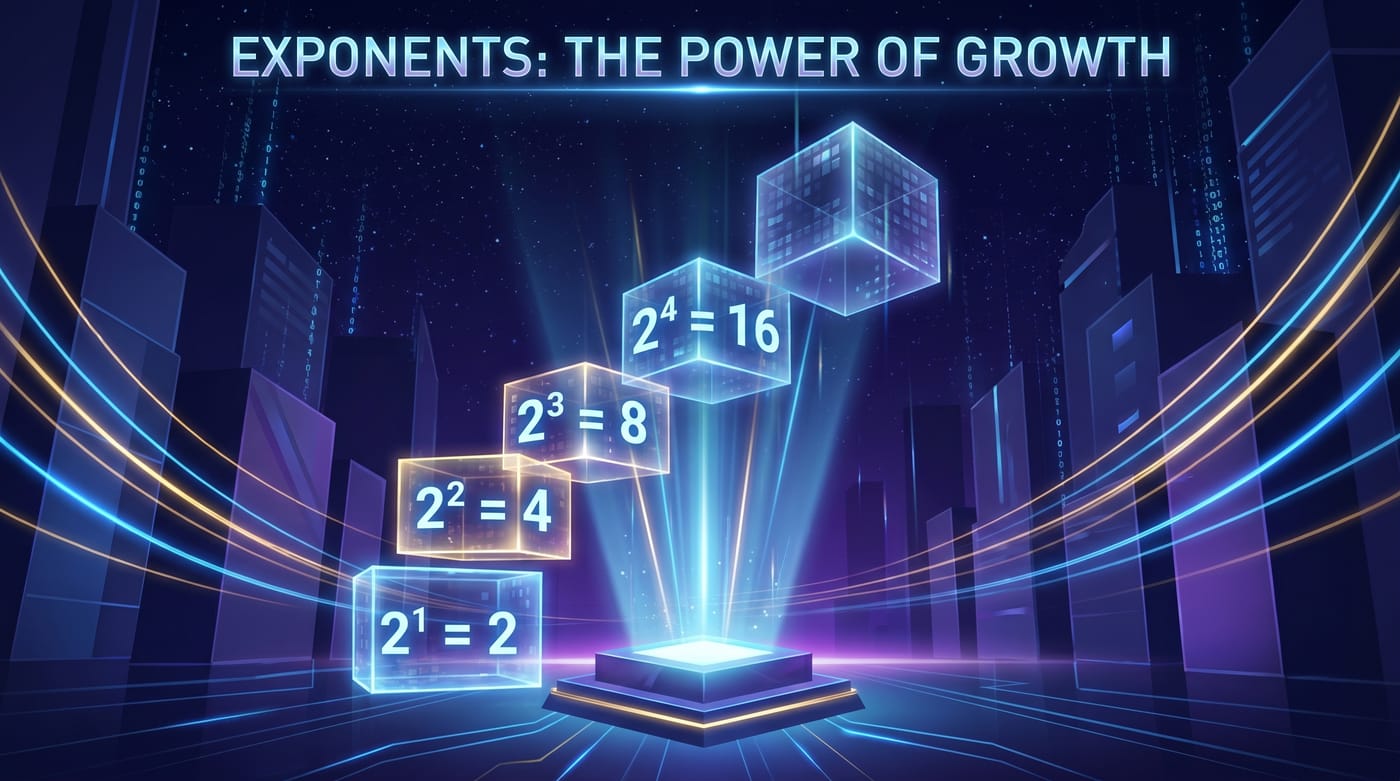
Lesson 4.1 — Exponents & Order of Operations
A shortcut for repeated multiplication — and the rules for what to do first.
🎙️ Narration script
Hey there! Today we're talking about exponents and the order of operations. Two big ideas, and they both make math faster and clearer.
Let's start with exponents. An exponent is just a shortcut for repeated multiplication. When you see two to the third power, that means two times two times two, which equals eight. Notice that's NOT two times three. The little number up top, the exponent, tells you how many times to use the base as a factor. So in two to the third power, two is the base and three is the exponent. We say "two squared" for the second power, and "two cubed" for the third power.
You see this in real life all the time. The area of a square is a side squared. Four squared is sixteen. And ten cubed is one thousand, which is super handy with big numbers.
Now, the order of operations. When an expression mixes adding, multiplying, and exponents, we need everyone to get the same answer. So we follow PEMDAS. Parentheses first, then Exponents, then Multiply and Divide, then Add and Subtract. One quick heads up: multiply and divide are equal partners, so you just work left to right. Same with add and subtract.
Here's a classic trap. What's three plus four times two? You might want to say fourteen, but multiplication comes first. Four times two is eight, then three plus eight is eleven.
Let's do a bigger one. Two plus three squared times the quantity four minus one. Parentheses first: four minus one is three. Exponent next: three squared is nine. Then multiply: nine times three is twenty-seven. Finally add: two plus twenty-seven is twenty-nine.
So, quick recap. An exponent is repeated multiplication, and PEMDAS keeps everyone on the same page. Nice work!
1 Core idea
An exponent is repeated multiplication: 2³ = 2 × 2 × 2 = 8 (the base 2, used as a
factor 3 times — not 2 × 3). When an expression mixes operations, the order of operations
(PEMDAS) tells you the sequence so everyone gets the same answer.
2 Key terms
- Base
- The number being multiplied (in 2³, the base is 2).
- Exponent / power
- How many times to use the base as a factor (the 3 in 2³).
- Squared / cubed
- To the 2nd power / 3rd power (5² = "5 squared").
- Order of operations
- PEMDAS: Parentheses → Exponents → ×÷ → +−.
3 Real-life examples
- Area of a square: side² → a 4-unit square has area 4² = 16.
- Powers of ten: 10³ = 1,000 (handy for place value & big numbers).
- Growth: a cell that doubles becomes 2⁵ = 32 after 5 splits.
Reveal the thinking
4 Common doubts
Is 2³ the same as 2 × 3?
No. 2³ = 2 × 2 × 2 = 8. The exponent counts how many times to multiply, not what to multiply by.
What's the PEMDAS order?
Parentheses → Exponents → Multiply/Divide → Add/Subtract.
Does multiply always come before divide?
No — they're the same rank: do them left to right. Same for add & subtract.
3 + 4 × 2 = ?
Multiply first: 4 × 2 = 8, then 3 + 8 = 11 (not 14).
5 Step-by-step · the PEMDAS ladder
📊 See it · worked example
- Evaluate 3 × 2² + 1.
answer
Exponent first: 2² = 4. Then multiply: 3 × 4 = 12. Then add: 12 + 1 = 13. - A friend says 4² = 8. What did they do wrong, and what is the right answer?
answer
They multiplied 4 × 2 (treating the exponent like a factor). 4² means 4 × 4 = 16.
Grounded in CA CCSS-M, Grade 6 · 6.EE.1 & 6.EE.2c (exponents, evaluating expressions), California Department of Education. Hero image generated with Gemini Nano Banana Pro.