Lesson 5.4 — Nets & Surface Area
Unfold a box flat and you can see — and add up — every face it's made of.
🎙️ Narration script
Hey! Let's talk about nets and surface area. Here's a neat idea: if you unfold a box flat, you can actually see every single face it's made of, and then just add them up.
So, a net is what you get when you unfold a 3D solid and lay it out flat. A box, a rectangular prism, unfolds into six rectangles. Each flat side is called a face, and a box has six of them.
Now, surface area is just the total of all those flat faces added together. Think of it as the amount of wrapping paper you'd need to cover the whole box, with no gaps and no overlaps. So the plan is simple: find the area of each face, then add them all up.
And here's a shortcut. The faces match in pairs. The top equals the bottom, the front equals the back, and the left equals the right. So you really only need to find three faces, double each one, and add.
Let's do a five by three by two box. The top is five times three, that's fifteen. The front is five times two, that's ten. And the side is three times two, that's six. Now use the pairs: two fifteens make thirty, two tens make twenty, and two sixes make twelve. Add those up, thirty plus twenty plus twelve, and you get sixty-two square units.
And don't mix this up with volume. Surface area is the outside skin, measured in square units. Volume is the space inside, measured in cubic units.
Quick recap. A net is a box unfolded into six rectangles. Surface area is the total of all the faces. Find each with length times width, use the matching pairs, add them up, and label in square units. Well done!
1 Core idea
A net is what you get when you "unfold" a 3D solid and lay it out flat. A box (rectangular prism) unfolds into 6 rectangles. The surface area is just the total of all those flat faces added together — the amount of paper you'd need to wrap the whole box with no gaps and no overlaps. So the plan is simple: find the area of each face, then add them up.
2 Key terms
- Net
- A flat pattern that folds up into a 3D shape.
- Face
- One flat side of a solid (a box has 6 faces).
- Rectangular prism
- A box shape with length, width, and height.
- Surface area
- The sum of the areas of all the faces, measured in square units.
- Area of a rectangle
- length × width.
3 Real-life examples
- Gift wrap: the paper to cover a present = the box's surface area.
- Cereal box: the cardboard used to make it (before folding) is its net.
- Painting a room: the paint needed for the walls and ceiling.
- Fish tank: the glass to build a tank covers its surface area.
Reveal the thinking
4 Common doubts
What's the difference between surface area and volume?
Surface area is the outside skin (square units, like cm²). Volume is the space inside (cubic units, like cm³).
Do I really have to find all 6 faces?
Yes — but they match in pairs. Top = bottom, front = back, left = right. So find 3 faces, double each, and add.
Why are the units "squared"?
Because area is length × width — two measurements multiplied — so the units multiply too: cm × cm = cm².
Can one box have different-looking nets?
Yes! A box can unfold many ways. They all use the same 6 faces, so the surface area is always the same.
5 Step-by-step (surface area from a net)
- Unfold the box into its 6 rectangles (the net).
- Find each face's area with length × width.
- Use the pairs: top = bottom, front = back, left = right.
- Add all 6 areas together.
- Label the answer in square units.
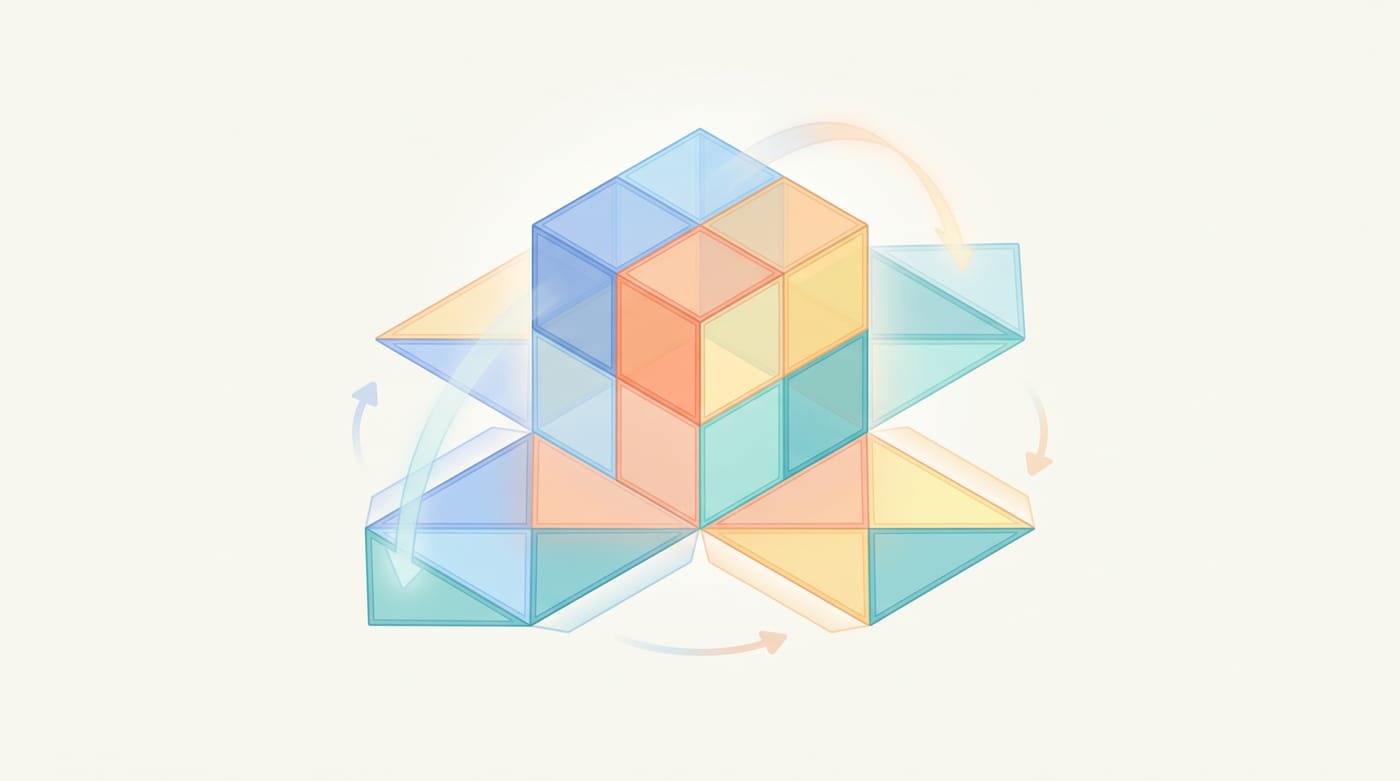
📊 See it · a 5 × 3 × 2 box unfolded into its net
Six faces, three matching pairs. Add them all: 2(15) + 2(10) + 2(6) = 30 + 20 + 12 = 62 square units.
- Find the surface area of a 2 × 2 × 3 box.
answer
Three faces: 2×2=4, 2×3=6, 2×3=6. Double each: 2(4) + 2(6) + 2(6) = 8 + 12 + 12 = 32 square units. - Why do we double each of the three faces instead of finding all six separately?
answer
The faces come in matching pairs — top = bottom, front = back, left = right — so each distinct face appears exactly twice.
length × width,
use the matching pairs (top = bottom, front = back, left = right), add them up, and label the answer
in square units.Grounded in CA CCSS-M, Grade 6 · 6.G (representing 3D figures with nets and using them to find surface area), California Department of Education. Hero image generated with Gemini Nano Banana Pro.