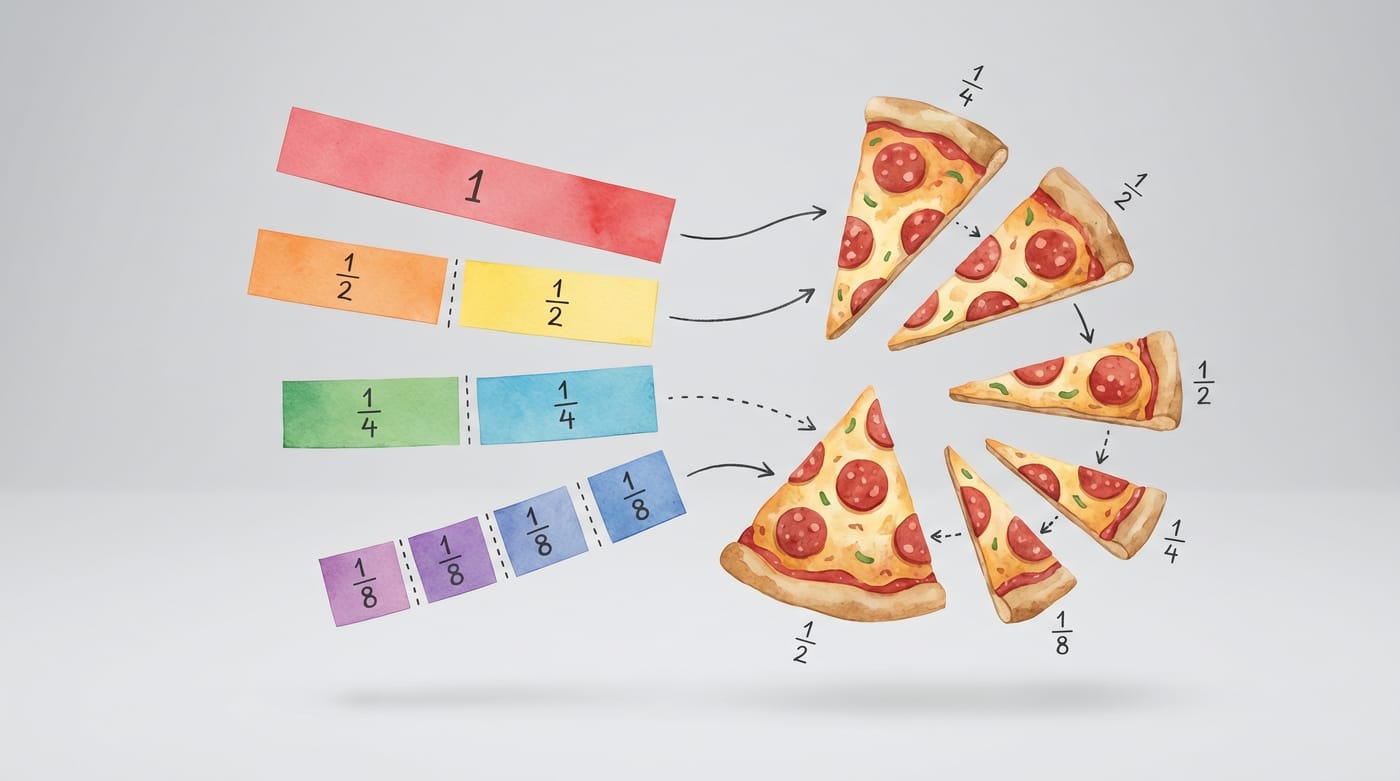
Lesson 2.1 — Dividing Fractions by Fractions
Dividing by a fraction asks: "how many of these fit into that?"
🎙️ Narration script
Hey there! Today we're dividing fractions, and I promise it's friendlier than it sounds.
Here's the big idea. Division really just asks one question: how many of these fit into that? So when you see three divided by one half, you're really asking, how many halves are there in three? Picture three whole pizzas, and you slice each one in half. That gives you six half-pieces. So three divided by one half equals six.
Now, you won't always want to draw pizzas, so here's the shortcut every mathematician uses. It's called keep, change, flip. Keep the first fraction exactly as it is. Change the divide sign into a multiply sign. And flip the second fraction upside down. That flipped fraction has a fancy name: the reciprocal. Three fourths flipped becomes four thirds. The number five flipped becomes one fifth.
Let's try one. How many eighths fit in three fourths? We write three fourths divided by one eighth. Keep three fourths. Change divide to multiply. Flip one eighth to eight over one. Now multiply across: three fourths times eight is twenty-four over four, which is six. Six eighth-pieces fit perfectly inside three fourths.
One thing that surprises a lot of students: dividing made the answer bigger! That's totally normal. When you divide by a number smaller than one, lots of little pieces fit inside, so the result grows.
Quick recap. Dividing by a fraction means how many fit. Use keep, change, flip: keep the first, change the sign, flip the second to its reciprocal, then multiply. That's it. You've got this!
1 Core idea
Division asks "how many fit?" So 3 ÷ 1/2 asks how many halves are in 3? — the
answer is 6. The shortcut for any fraction division: multiply by the reciprocal (flip the
second fraction). Dividing by 1/2 is the same as multiplying by 2.
3/4 ÷ 1/8 is just asking "how many ⅛-inch tick marks fit between 0 and ¾?" — line them up and count: six ticks fit, so the answer is 6.
1/2 ÷ 3/4 = 2/3, where less than one tick fits and the answer is itself a fraction you can't tidily count off.2 Key terms
- Dividend
- The number being divided (the first one).
- Divisor
- The number you divide by (the second one — the one you flip).
- Reciprocal
- A fraction flipped upside down: 3/4 → 4/3. (Multiplying a number by its reciprocal gives 1.)
- Keep–Change–Flip
- Keep the first fraction, change ÷ to ×, flip the second.
3 Real-life examples
- Cooking: How many ½-cup scoops in 3 cups?
3 ÷ 1/2 = 3 × 2 = 6. - Ribbon: How many ⅛-meter pieces in ¾ meter?
3/4 ÷ 1/8 = 3/4 × 8 = 6. - Sharing:
1/2 ÷ 1/4 = 1/2 × 4 = 2— two quarter-pieces fill a half.
2 ÷ 1/3 come out bigger than 2?
Reveal the thinking
2 ÷ 1/3 = 6. Whenever you divide by something less than 1, the answer gets bigger.4 Common doubts
Why does flipping (the reciprocal) work?
Dividing by 1/2 means "how many halves fit," which is the same as multiplying by 2 — the reciprocal of 1/2.
Which fraction do I flip?
Always the second one (the divisor). Never flip the first.
Why did dividing make the answer bigger?
When you divide by a number less than 1, lots of small pieces fit — so the result grows.
What's a reciprocal again?
Swap top and bottom: 3/4 → 4/3, and 5 → 1/5.
5 Step-by-step · Keep–Change–Flip
3/4
3/4 ×
× 8/1
- Keep the first fraction: 3/4.
- Change ÷ to ×.
- Flip the divisor to its reciprocal: 1/8 → 8/1.
- Multiply across and simplify: 3/4 × 8/1 = 24/4 = 6.
📊 See it · how many ⅛ fit in ¾?
Six ⅛-pieces fit inside ¾ — exactly what the math says.
- Compute
5/6 ÷ 1/3.answer
Keep–change–flip: 5/6 × 3/1 = 15/6 = 5/2 = 2½. - Which is larger,
4 ÷ 1/2or4 × 1/2, and why?answer
4 ÷ 1/2 = 8is larger; dividing by a number less than 1 grows it, while4 × 1/2 = 2shrinks it.
Grounded in CA CCSS-M, Grade 6 · 6.NS.1 (dividing fractions by fractions), California Department of Education. Hero image generated with Gemini Nano Banana Pro.