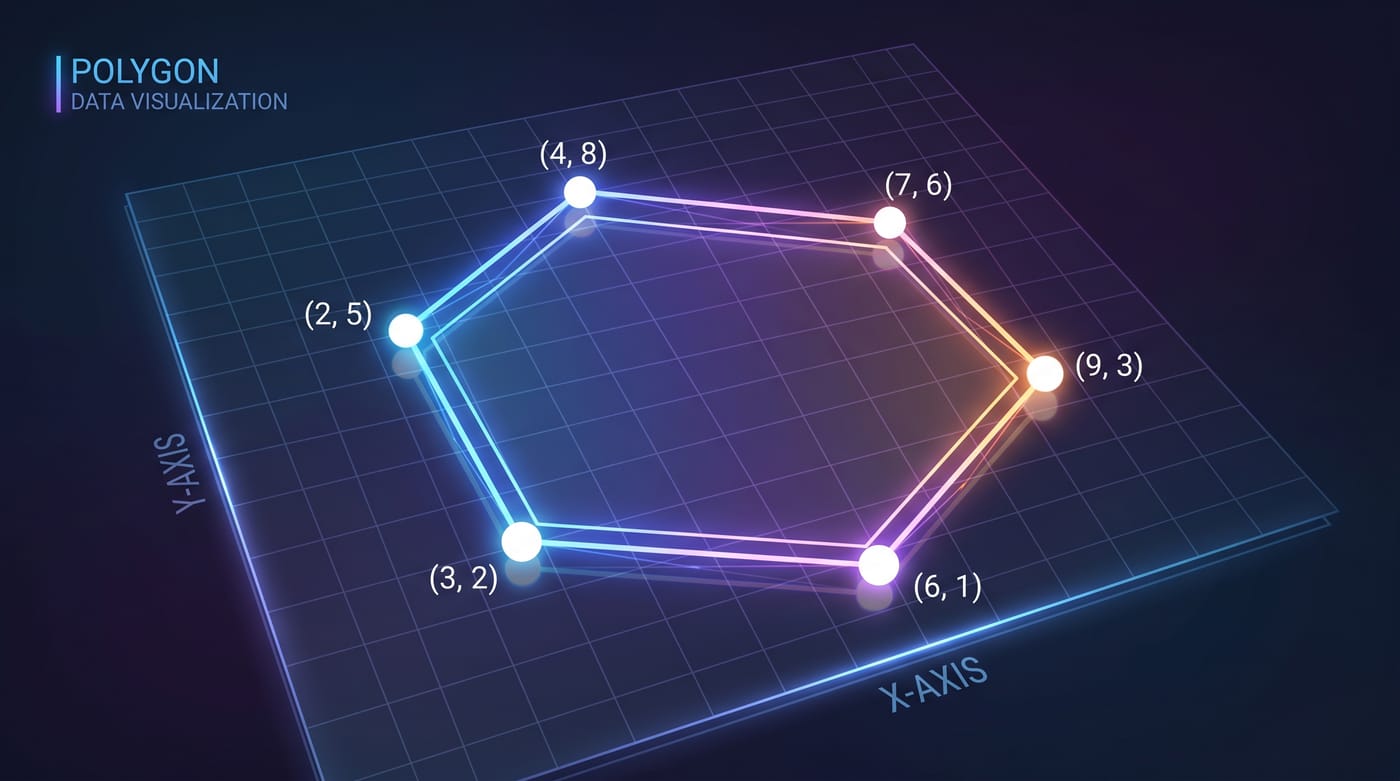
Lesson 5.2 — Polygons on the Coordinate Plane
Give every corner an address (x, y), and you can build shapes — and measure their sides — without ever picking up a ruler.
🎙️ Narration script
Hey there! Let's talk about polygons on the coordinate plane. Here's the cool part: once you give every corner an address, you can measure the sides of a shape without ever picking up a ruler.
First, what's a polygon? It's just a closed flat shape made of straight sides, like a triangle, a rectangle, or a hexagon. The corners are called vertices.
Now we put those corners on a coordinate plane, a grid with a horizontal x-axis and a vertical y-axis. Each corner gets an address written as an ordered pair, x comma y. The x tells you how far right, and the y tells you how far up. And order matters, x always comes first. Think of it this way: you walk down the hall before you go up the stairs.
Here's the magic. If two corners sit on the same horizontal line, meaning they share the same y-value, the side between them is just the difference of their x-values. And if they share the same vertical line, same x-value, the side is the difference of their y-values. No measuring, you just subtract.
Let's try it with a rectangle. The corners are at one comma one, five comma one, five comma four, and one comma four. The bottom side goes from x equals one to x equals five. So five minus one is four units. The left side goes from y equals one to y equals four. So four minus one is three units. We've got a four-by-three rectangle.
One tip: always subtract the smaller number from the bigger one, so your length stays positive. Distance is never negative.
Quick recap. Every corner has an address, x then y. For a horizontal side, subtract the x-values. For a vertical side, subtract the y-values. Bigger minus smaller, every time. Great job!
1 Core idea
A polygon is a closed flat shape made of straight sides (a triangle, rectangle, hexagon…).
When we place its corners — called vertices — on a coordinate plane, each corner gets an
address written as (x, y): how far right, then how far up. The magic part: if two vertices
sit on the same horizontal line, the length of the side between them is just the difference of their
x-values. If they share the same vertical line, the side is the difference of their y-values.
No measuring needed — you subtract.
2 Key terms
- Coordinate plane
- A grid made by a horizontal x-axis and vertical y-axis crossing at the origin.
- Ordered pair (x, y)
- A point's address: x = steps right, y = steps up. Order matters.
- Vertex (plural: vertices)
- A corner of a polygon where two sides meet.
- Polygon
- A closed shape with straight sides (triangle, rectangle, pentagon…).
- Side length
- The distance along one edge. On a grid line, it's the difference of the matching coordinates.
3 Real-life examples
- Garden plot: Mark fence posts at (1, 1), (5, 1), (5, 4), (1, 4) to lay out a rectangular garden.
- Video games: A map stores each wall corner as an (x, y) pair so the screen knows where to draw it.
- Floor plan: An architect places room corners on a grid and finds wall lengths by subtracting.
- Pixel art: Each colored square on a screen has a coordinate address — just like a vertex.
Reveal the thinking
4 Common doubts
Which number comes first in (x, y)?
x always comes first (right/left), then y (up/down). Remember: you walk down the hall before you go up the stairs.
How do I find a side length without measuring?
If the two corners share the same y (a flat side), subtract the x-values. If they share the same x (an upright side), subtract the y-values. Always do bigger − smaller so the length is positive.
Can a side length ever be negative?
No. Length is a distance, so it's always positive. Subtract the smaller coordinate from the larger one.
What if a side is slanted (diagonal)?
Then you can't just subtract — that's a later lesson. For now we find lengths only on horizontal or vertical sides.
5 Step-by-step (find a side length)
- Plot the two vertices on the grid using their (x, y) addresses.
- Check whether they share a y-value (horizontal side) or an x-value (vertical side).
- Subtract the matching coordinates: bigger − smaller.
- Label the answer as the side length (in units).
📊 See it · a rectangle on the grid
Bottom side: x goes 1 → 5, so length = 5 − 1 = 4 units. Left side: y goes 1 → 4, so length = 4 − 1 = 3 units.
Find the side lengths of the rectangle:
- How long is the side from (2, 3) to (7, 3)?
answer
Same y, so subtract x's: 7 − 2 = 5 units. - How long is the side from (2, 3) to (2, 9)?
answer
Same x, so subtract y's: 9 − 3 = 6 units.
Grounded in CA CCSS-M, Grade 6 · 6.G (polygons in the coordinate plane), California Department of Education. Hero image generated with Gemini Nano Banana Pro.