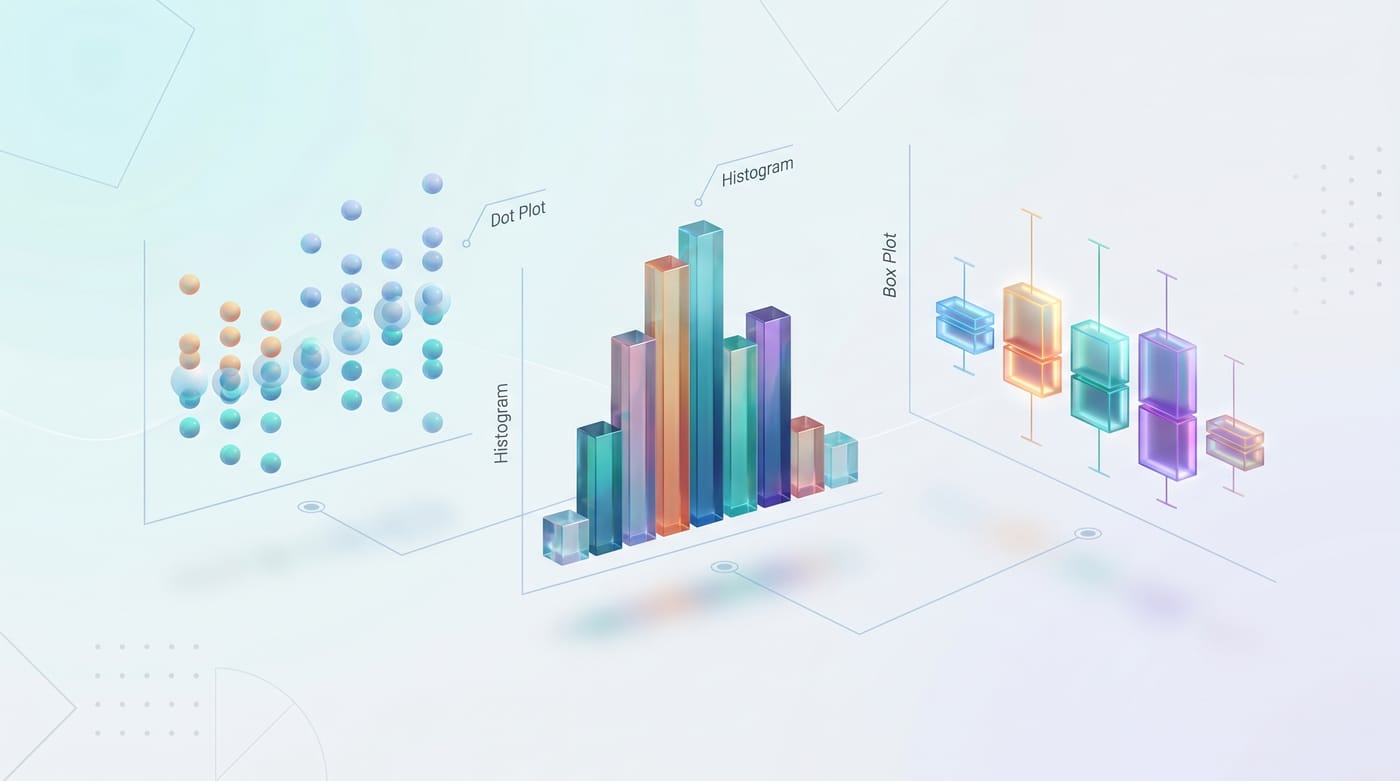
Lesson 6.4 — Dot Plots, Histograms & Box Plots
The same set of numbers can be drawn three different ways — and each picture tells you something the others hide.
🎙️ Narration script
Hey! Today we're going to draw data three different ways. Here's the cool thing: the same set of numbers can be shown as three different pictures, and each one reveals something the others hide.
A long list of numbers is hard to "see." A graph turns that list into a shape you can read at a glance. Let's meet our three graphs.
First, the dot plot. You stack one dot above the number line for each data point. It's perfect for small sets, because you can count every single value.
Second, the histogram. This one groups values into equal-width intervals called bins, and draws a bar for each bin. The bar's height shows how many values landed in that group. One important thing: in a histogram, the bars touch, with no gaps, because the number line is continuous. That's different from a bar graph, where the bars have gaps because they count separate categories like favorite colors.
Third, the box plot. It's built from five key numbers, called the five-number summary: the minimum, Q1, the median, Q3, and the maximum. The box runs from Q1 to Q3, so it holds the middle fifty percent of your data, and the whiskers stretch out to the smallest and largest values.
Let's use one example: books read by eleven students. With a dot plot, you see every student. With a histogram, you group them, like two-to-three, four-to-five, and so on. With a box plot, you get the five-number summary, two, three, five, six, nine, and you can see the spread.
So when do you use each? Use a dot plot when the set is small and every value matters. Use a histogram when there's lots of data to group. And use a box plot when you care about the median and spread, or want to compare two groups side by side.
Quick recap. Same data, three pictures. Pick the one that answers your question!
1 Core idea
When you collect data, a long list of numbers is hard to "see." A graph turns that list into a shape you can read at a glance. Three classic graphs are the dot plot (one dot per data point), the histogram (bars over equal-width intervals), and the box plot (a five-number summary of how the data spreads). They all describe the same data — they just zoom in on different things: individual values, groups, or spread.
2 Key terms
- Dot plot
- A number line with one dot stacked above a value for each data point. Great for small sets.
- Histogram
- Bars over equal-width number intervals (called bins); the bar's height is how many values land in that bin. Bars touch — no gaps.
- Box plot
- A box-and-whisker diagram built from five key numbers showing the middle and the spread.
- Median
- The middle value when the data is in order.
- Quartiles (Q1, Q3)
- The medians of the lower half and the upper half — they cut the data into four parts.
- Five-number summary
- Minimum, Q1, median, Q3, maximum — the five numbers a box plot is made from.
3 Real-life examples
- Dot plot: the number of pets each of 20 classmates owns (0, 1, 2…) — you can count every kid.
- Histogram: the ages of 500 people at a fair, grouped into 0–9, 10–19, 20–29… — too many to dot one by one.
- Box plot: comparing test scores in two classes — one box next to another shows which class scored higher and which was more spread out.
- All three: minutes students spent reading last night — pick the chart that answers your question.
Reveal the thinking
4 Common doubts
What's the difference between a histogram and a bar graph?
A bar graph counts categories (like favorite colors) and the bars have gaps. A histogram counts number intervals and the bars touch, because the number line is continuous.
Why can't I read individual values from a histogram or box plot?
You can't — they summarize. A bin of "4–5: five students" doesn't tell you who got 4 and who got 5. Use a dot plot when each value matters.
Does the box plot's box hold half the data?
Yes. The box runs from Q1 to Q3, so about the middle 50% of the data sits inside it.
Is the median always in the center of the box?
No. The line marks the median, but it can sit closer to one side if the data is lopsided (skewed).
5 Step-by-step (build a box plot)
- Order the data from least to greatest.
- Find the median — the middle value.
- Find Q1 and Q3 — the medians of the lower half and the upper half.
- Note the min and max — the smallest and largest values.
- Draw the box from Q1 to Q3, a line at the median, and whiskers out to the min and max.
📊 See it · one data set, three charts
Books read over the summer by 11 students, in order:
2, 3, 3, 4, 4, 5, 5, 5, 6, 7, 9
When to use each: a dot plot when the set is small and every value matters; a histogram when there's lots of data to group into intervals; a box plot when you mainly care about the median and spread, or want to compare two groups side by side.
- From the box plot's five-number summary 2, 3, 5, 6, 9, what is the IQR, and what fraction of the data sits inside the box?
answer
IQR = Q3 − Q1 = 6 − 3 = 3. The box runs from Q1 to Q3, so it holds the middle 50% (about half) of the data. - A bar graph of favorite colors has gaps between its bars, but a histogram of test scores has bars that touch. Why?
answer
A bar graph counts separate categories (colors) that aren't on a continuous scale, so gaps show they're distinct. A histogram counts number intervals on a continuous number line, so touching bars show the values flow with no breaks.
Grounded in CA CCSS-M, Grade 6 · 6.SP (display numerical data in plots on a number line — dot plots, histograms, and box plots), California Department of Education. Hero image generated with Gemini Nano Banana Pro.