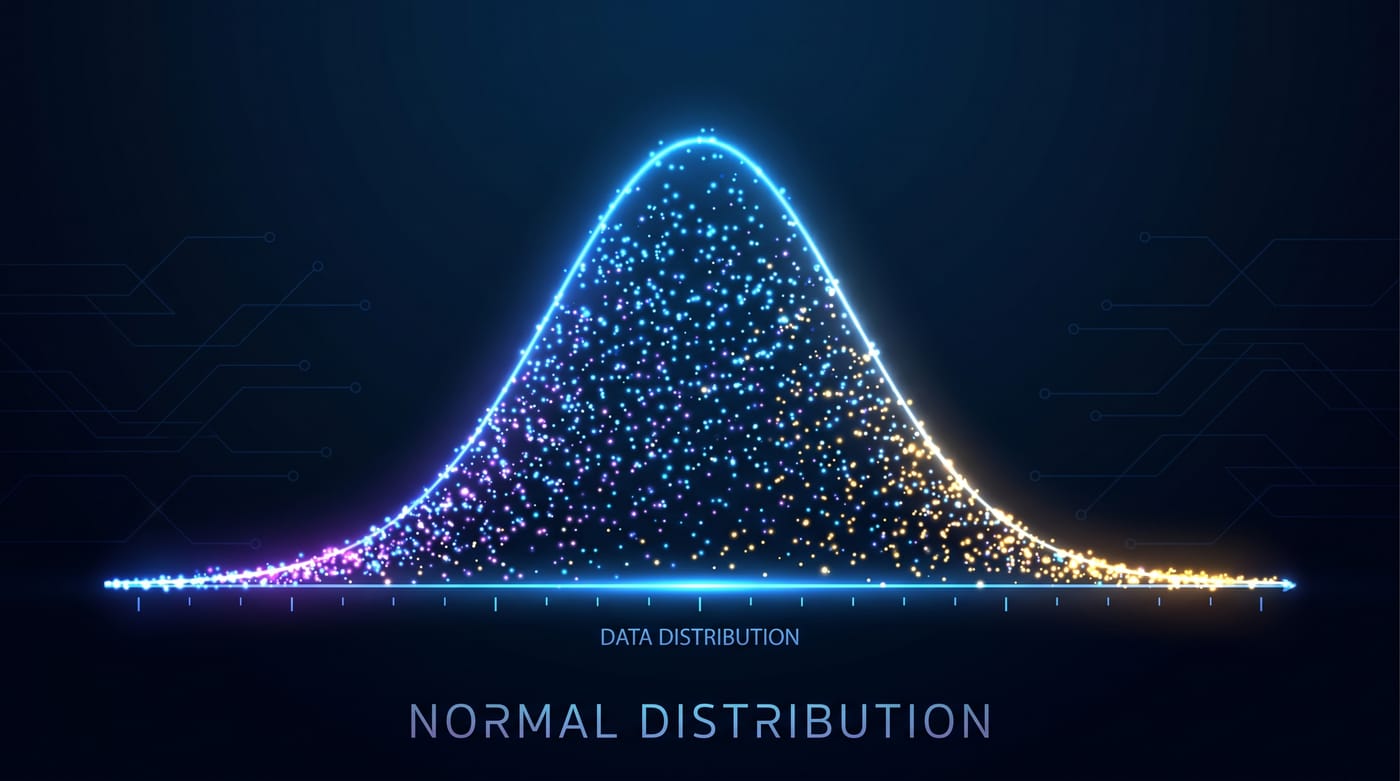
Lesson 6.1 — Statistical Questions & Distributions
A good data question expects many different answers — and those answers, plotted together, tell a story.
🎙️ Narration script
Hey there! Today we're going to figure out what makes a question a statistical question. It sounds fancy, but the idea is really simple.
A statistical question is one where you expect to get lots of different answers. Think about asking, "How tall are the students in my class?" Everybody's a little different, right? So you'd get a whole bunch of answers. That's a statistical question.
Now compare that to "How tall am I?" There's only one answer to that. It doesn't vary. So that one is not statistical.
Here's the key word: variability. That's just a way of saying how much the answers differ from one another. When answers vary, the question is statistical.
So let's try a few. "How many hours do sixth graders sleep each night?" Lots of different answers, so yes, statistical. "How many pets does each student own?" Again, all kinds of answers, so yes. But "What is the capital of California?" There's one answer, Sacramento, so that's not statistical.
Once you collect all those varying answers, you can plot them on a number line. The pattern you see is called a distribution. The distribution shows you which values are common, which are rare, and how spread out everything is.
In our pets example, fifteen students answered, and the data peaked at two pets, with answers ranging all the way from zero to five.
So here's the trick to spot a statistical question. Just ask yourself: "Would I expect more than one answer?" If yes, it's statistical. If there's only one true answer, it's not.
Quick recap. Statistical questions expect answers that vary. Plot those answers and you get a distribution, the shape of your data. Nice work today!
1 Core idea
A statistical question is one you expect to get lots of different answers to — answers that vary. "How tall are the students in my class?" is statistical, because students have many different heights. "How tall am I?" is not statistical — it has just one answer. When you collect all those varying answers and look at them together, their pattern is called a distribution: it shows which values are common, which are rare, and how spread out the data is.
2 Key terms
- Statistical question
- A question that anticipates variability — you expect many different answers.
- Variability
- How much the answers differ from one another.
- Data
- The collection of answers (values) you gather.
- Distribution
- The overall pattern of the data — where values cluster, peak, or spread out.
- Dot plot
- A graph that stacks one dot for each data value above a number line.
3 Real-life examples
- Statistical: "How many hours do sixth graders sleep each night?" → answers vary.
- Statistical: "How many pets does each student in my class have?" → answers vary.
- Not statistical: "How many pets do I have?" → one fixed answer.
- Not statistical: "What is the capital of California?" → one answer (Sacramento).
Reveal the thinking
4 Common doubts
How do I tell if a question is statistical?
Ask: "Would I expect more than one answer?" If yes, it's statistical. If there's only one true answer, it's not.
Is "How old are you?" statistical?
No — asked of one person, there's a single answer. But "How old are the students in this class?" is statistical, because ages vary.
What's the difference between data and a distribution?
Data is the raw list of answers. The distribution is the shape you see when you graph them all together.
Does a statistical question always use numbers?
Usually in 6th grade, yes — like heights, counts, or times. The key is that the answers vary.
5 Step-by-step (spot a statistical question)
- Read the question and picture who you'd ask.
- Predict the answers: would they all be the same, or would they vary?
- Decide: answers vary → statistical; one fixed answer → not statistical.
- Collect & plot the varying answers to see the distribution.
📊 See it · a distribution & two kinds of questions
"How many pets does each student in my class have?" — 15 students answered:
15 dots in all: 2 + 4 + 5 + 2 + 1 + 1 = 15. The data peaks at 2 pets and spreads from 0 to 5.
| Question | Statistical? | Why |
|---|---|---|
| How tall are the students in my class? | ✓ | Heights vary — many different answers. |
| How tall am I? | ✗ | One person, one fixed answer. |
- Is "How many minutes did each student spend on homework last night?" a statistical question?
answer
Yes — the minutes will vary from student to student, so you expect many different answers. - In the pets dot plot above (0:2, 1:4, 2:5, 3:2, 4:1, 5:1), which value is most common, and what is the range of the data?
answer
The tallest stack is at 2 pets (5 students), so 2 is most common. The data runs from 0 to 5, so the range (how far the data spreads, max − min) is 5 − 0 = 5.
Grounded in CA CCSS-M, Grade 6 · 6.SP.1 (statistical questions & distributions), California Department of Education. Hero image generated with Gemini Nano Banana Pro.